

Why and How to Measure for Clothing
Style Guide · The House of CO-KÝ
Finding a piece worth keeping is only half the equation. The other half is making sure it fits. Here is a clear, no-guesswork guide to taking your body measurements at home — so when something catches your eye, you can order with confidence.
There is nothing more frustrating than finding a piece that stops you mid-scroll. The right silhouette, the right detail, the kind of thing people ask about later. And then it arrives and does not fit.
It happens more often than it should, and rarely because the piece was wrong. More often, it comes down to one thing: not knowing your measurements.
Clothing sizing is not consistent across brands, countries, or even collections within the same label. A size that fits perfectly in one place can run completely different somewhere else. The only number that stays the same is your own. Once you know it, shopping online stops being a guessing game and starts feeling more intentional. Which, honestly, is how it should feel.
Here is everything you need to take your measurements accurately at home.
What you will need
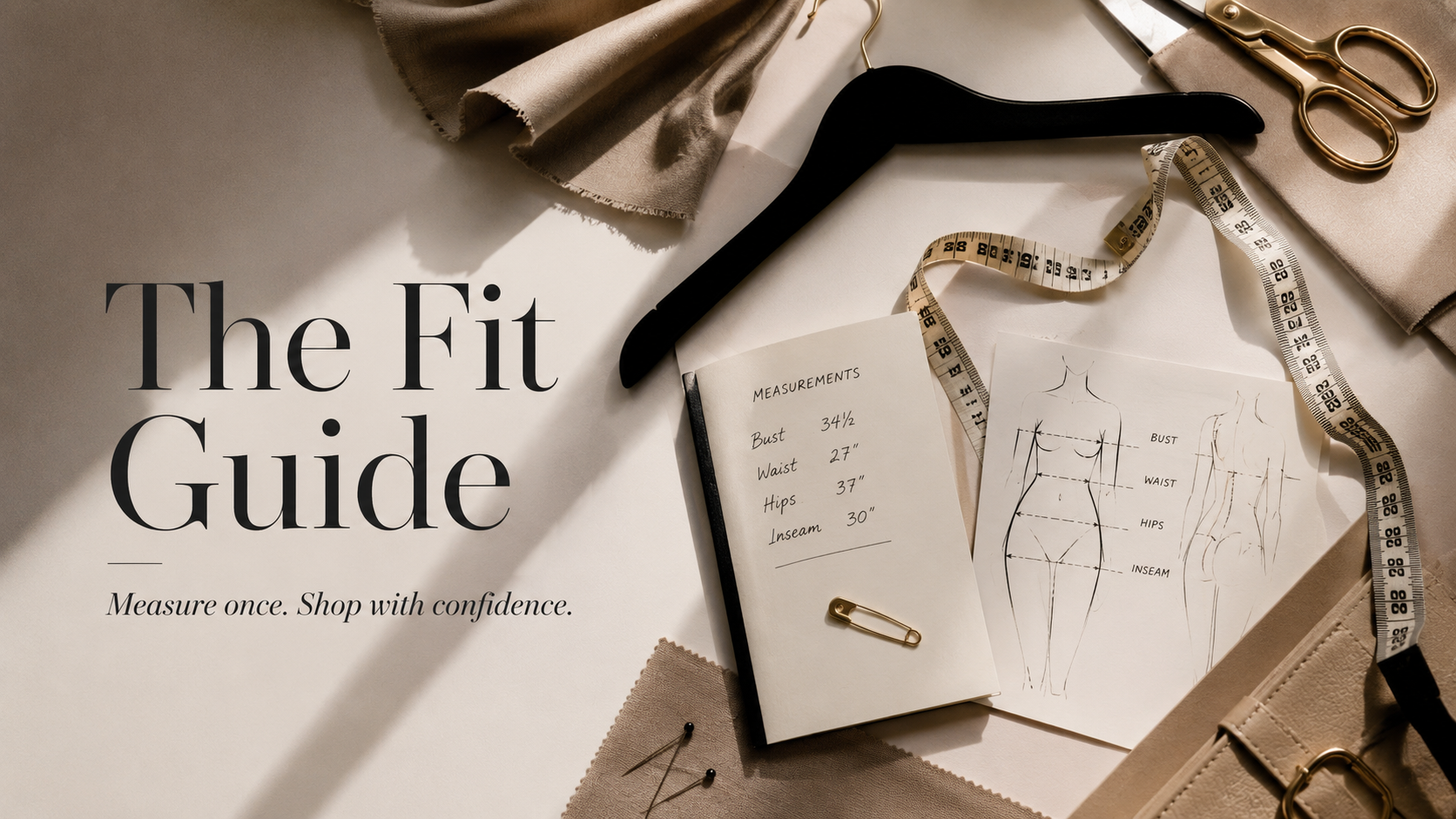
Just one tool: a soft cloth measuring tape. The kind used in tailoring and dressmaking. It is flexible enough to follow the curves of your body, which gives you a far more accurate read than a rigid tape measure.
A few simple rules before you start. Measure on bare skin, not over clothing — clothes add volume and distort the number. Keep the tape snug against the body but not pulled tight. Stand naturally and breathe normally. You want the measurement to reflect how you actually live in clothes.
And if you can, take your measurements in the morning. Before meals, before the day settles in. Your body is most consistent at that time and the reading will be cleaner.
The four measurements that matter most
When shopping for women's clothing online, particularly dresses, tops, sets, and fitted pieces, four measurements will answer almost every sizing question: bust, waist, hips, and inseam.
Bust
Wrap the measuring tape around the fullest part of your chest, passing it under both arms and straight across your shoulder blades at the back. Keep the tape level and snug but not tight. You should be able to breathe comfortably.
Wear a smooth, non-padded bra for the most accurate result. A heavily padded style adds extra volume and will throw off the number.
Waist
Your natural waist is the narrowest part of your torso, sitting roughly two inches above your belly button. To find it, stand straight and bend gently to one side. The small crease that forms is your natural waistline.
Wrap the tape around that point and record the number. Stand tall, breathe normally, and resist the urge to hold anything in. This measurement should reflect how you actually wear clothes.
Stand tall and breathe normally. Do not hold in.
Hips
Stand with your feet together and wrap the tape around the fullest part of your hips and seat, typically about eight inches below your natural waist. Use a mirror to check that the tape is level all the way around.
If you are sizing for trousers, wide-leg cuts, or tailored skirts, you can also measure your thigh circumference at its widest point.
Also measure the thigh at its fullest point when sizing for trousers or wide-leg styles.
Inseam
The inseam is the distance from the uppermost inner point of your thigh down to your ankle. It determines how trousers, wide-leg pants, and maxi skirts will fall on your frame.
The easiest way to measure it is to take a well-fitting pair of trousers you already own, lay them flat on a surface, and measure from the crotch seam straight down to the hem.
Lay trousers flat and measure from the crotch seam straight to the hem. That number is your inseam.
The right fit does not just change how a piece looks. It changes how it feels to wear it — and the impression it leaves when you walk into a room.
A few things worth keeping in mind
Sizing varies across every label, so your measurements will always be more useful than a generic size tag. When in doubt, trust the measurements rather than the size you have worn elsewhere.
If you are between two sizes on a fitted dress or structured piece, sizing up is almost always the more comfortable choice. A skilled tailor can take something in. No one can let out fabric that was never there.
If a piece has specific fit notes — a stretch blend, a structured bodice, or an oversized cut — those details are always worth reading before you decide. They change how you interpret the numbers.
Without your measurements
- Guessing between sizes every order
- Returns because a beautiful piece did not fit
- Relying on size labels that vary by brand
- Second-guessing every online purchase
- Missing pieces you would have loved
With your measurements
- Ordering with clarity and confidence
- Fewer returns, less friction
- One consistent reference across every label
- Knowing when to size up on a structured cut
- Getting more out of every find
How to use your measurements when shopping online
Once you have your four measurements written down, the process is straightforward. On any product page, look for the sizing chart and compare your numbers to the measurements listed for each size. Most well-curated online boutiques provide this at the product level rather than as a single generic guide.
At The House of CO-KÝ, each piece includes a sizing chart alongside fit notes and styling details. If you are shopping for a statement dress, a tailored set, or a special occasion piece, those notes will tell you how the piece is cut and whether it runs true to size.
When the fit is right, the piece carries itself. And that is the whole point.
CO-KÝ Style Notes
How to use your measurements at The House
- For fitted and structured dresses: Bust and waist are your most critical measurements. Lead with those when checking the size chart.
- For wide-leg trousers and tailored sets: Waist and hips do the most work. If you are between sizes, the hip measurement is usually the deciding factor.
- For occasion pieces with movement: Flowy midi dresses and draped styles are more forgiving. Check the length notes alongside your inseam to make sure the hem falls where you want it.
- On sizing up: For any piece with a structured waistband, a defined bodice, or a close cut, sizing up is almost always the right call if you are on the border. Fabric can be taken in. It cannot be added.
- On fit notes: Every piece in the House includes notes on how it fits. Read them before you check the chart. They are written to help you decide — not to sell you on a size.
- Keep your numbers somewhere easy to find. Saved in your phone, written in your notes app, bookmarked on the sizing chart page. Thirty seconds of preparation removes the guesswork from every future order.
Frequently asked questions
How do I measure my body for women's clothing?
Take four key measurements using a soft cloth tape: bust (around the fullest part of the chest), waist (around the narrowest point, roughly two inches above the navel), hips (around the fullest part of the seat, about eight inches below the waist), and inseam (from the upper inner thigh to the ankle). Measure on bare skin with the tape snug but not tight.
Why do clothes not fit even when I order my usual size?
Clothing sizing is not standardized. A Small or Medium varies significantly from one brand to another and even between collections within the same label. Your body measurements in inches or centimeters are the only consistent reference point. Using them removes the guesswork entirely.
What is the most important measurement for buying a dress online?
For most dresses, bust and waist are the primary starting points. If the dress has a defined waist or structured bodice, these two measurements will determine fit more than anything else. For wrap styles and flowy silhouettes, hip measurement becomes equally important.
When is the best time to take body measurements?
Morning is ideal, before meals and before the day's activity. Your body is most settled and consistent at that time, giving you the most accurate read.
Do I need to remeasure myself regularly?
It is worth updating your measurements every six to twelve months, or any time your body changes. Even small shifts can affect how a fitted or tailored piece sits.
How do I use my measurements when shopping at The House of CO-KÝ?
Each product page includes a sizing chart. Compare your bust, waist, and hip measurements to the chart for that specific piece. If you fall between two sizes, the fit notes on the page will guide your decision. You are also welcome to reach out to us directly and we will help.

Written by TheHouse OfCoky

Leave a comment
This site is protected by hCaptcha and the hCaptcha Privacy Policy and Terms of Service apply.